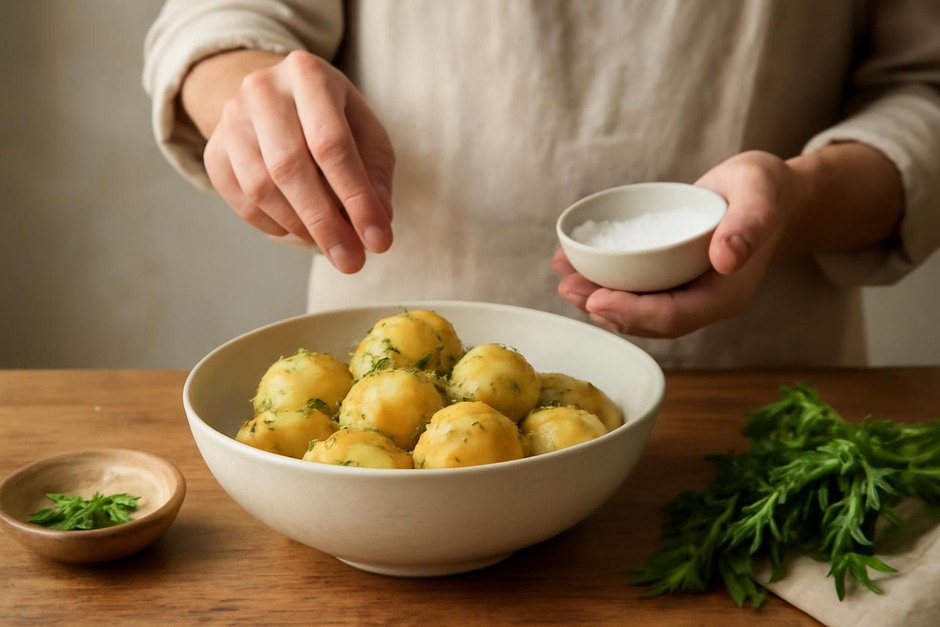
Five Small Experiments to Train Your Seasoning Sense
Why seasoning matters (a short historical note)
For most of culinary history, people prized seasoning partly for preservation and partly for pleasure. Salt was a trade good and an essential food preservative; spices helped mask the flavors of older methods of storage and also signaled wealth and travel. In everyday kitchens, cooks developed simple rules—add salt early or late depending on texture, finish with acid to brighten—long before they were written down. Today, those rules remain useful, but the fastest way to learn them is through taste.
How to use these experiments
Each experiment takes 5–15 minutes and uses one plain base (a boiled potato, a cup of cooked rice, or a plain bean). Keep a notebook or phone nearby and note what you taste. The goal is not a perfect recipe but a clearer sense of how one change at a time affects flavor and texture.
-
Experiment 1 — Salt: find the moment when food comes alive
Why: Salt enhances existing flavor and can change perceived texture. Try this to notice how little makes a big difference.
Do this: Split a warm boiled potato into three equal pieces (or three small bowls of rice/beans). Leave one plain. Salt the second lightly (a pinch, 1/8 tsp), and salt the third more heavily (1/4 tsp). Taste each.
What to notice: Does the salted piece taste more like itself? At what point does salt become obvious or too much? Try adjusting: add a tiny extra pinch to the lightly salted piece and see how that changes your perception.
-
Experiment 2 — Acid: brighten and lift flavors
Why: Acid (vinegar, lemon juice) can make food taste fresher and reduce the need for salt. It often pairs with salt to create balance.
Do this: Take a small portion of your base (potato/rice/beans). Add 1/2 teaspoon lemon juice to one portion and 1/2 teaspoon mild vinegar (like apple cider) to another. Keep a plain piece for comparison.
What to notice: Does acid make the food seem lighter or cleaner? Does it bring out sweetness or make bitterness more noticeable? Try adding a tiny pinch of salt after acid and see how the combination shifts the flavor.
-
Experiment 3 — Fat: smoothness and mouthfeel
Why: Fat (olive oil, butter) carries flavor and coats the mouth, rounding out sharp notes from salt and acid.
Do this: On three small portions, drizzle a little olive oil on one, a pat of butter on another, and leave one dry. Use about 1/2 teaspoon for each portion.
What to notice: Which feels richer or more satisfying? Does fat mute some flavors or highlight others? Combine fat with a previously seasoned piece (salted or acidified) to see how it smooths the edges.
-
Experiment 4 — Heat and timing: when to add seasonings
Why: Temperature changes how we perceive taste. Some flavors develop with heat; others are brighter when added at the end.
Do this: Warm one portion of your base and season it with salt before heating and another after heating. Try a heated portion with a little oil added while warm, and another where oil is added cold.
What to notice: Does salt added before heating meld into the food differently than salt added after? Does warm oil smell and taste more fragrant? These small differences can guide whether you season early in a recipe or finish at the table.
-
Experiment 5 — Herbs and spices: subtle finishing touches
Why: Fresh herbs and mild spices change aroma and perception more than fundamental taste. They can be the finishing touch that makes a simple dish memorable.
Do this: Take a portion seasoned with the balance of salt, acid, and fat that you prefer from earlier experiments. Add a small pinch of chopped parsley, a mint leaf, a grind of black pepper, or a dusting of smoked paprika to different tastes.
What to notice: Which additions feel like enhancements rather than cover-ups? Fresh herbs usually brighten; ground spices add warmth. Try crushing an herb between your fingers first—aroma often predicts taste.
Putting it together
After these experiments, try building a simple plate: a warm boiled potato dressed with a measured pinch of salt, a squeeze of lemon, a drizzle of olive oil, and a small scattering of parsley. Notice which step made the biggest change. Repeat with other ingredients—steamed greens, roasted carrots, a bowl of lentils—and you’ll start to recognize patterns.
Seasoning is less a set of rules than a practiced habit of tasting and adjusting. These short experiments, done in your kitchen over a few afternoons, teach you to trust your palate and to know what a dish needs. As with any skill, small, regular practice is the fastest path to steady improvement.